Process
How Long Does a Custom Cabinet Project Take? (Step-by-Step Timeline)
From first consultation to final walkthrough, week by week. A realistic look at how long custom cabinets take to design, build, and install — and where the time honestly goes.
How long do custom cabinets take? It is one of the first questions a homeowner asks, and the honest answer is a range: most custom kitchens run eight to fourteen weeks from approved drawings to final walkthrough, with the design phase adding several weeks before that. But a range is not very useful on its own. What helps is seeing where the weeks actually go — because almost every step in a custom cabinet project is time spent removing risk, and understanding that makes the wait far easier to live with.
Almost every step in a custom cabinet project is time spent removing risk before a single board is cut.
Phase one — Consultation and design (2 to 6 weeks)
Week 1: The first conversation
It begins with a conversation, at your home or in our Gilroy shop. We want to understand how you actually use the kitchen — who cooks, where things should live, what frustrates you about the room today — and to look at the space itself. We talk budget honestly and early, because a realistic figure shapes every decision that follows. There is no reason to design a kitchen no one intends to build.
Weeks 2 to 4: Drawings and design development
We measure the room precisely, then begin drawing — plans, elevations, and 3D views so you can see the kitchen before it exists. This is a back-and-forth, not a single reveal. We refine the layout, settle door style and finish, choose hardware, and resolve the small decisions that quietly determine whether a kitchen works: drawer placement, the height of a hood, where the trash actually goes. Time invested here is the cheapest time in the entire project. A change on paper costs nothing; the same change in finished walnut is expensive.
Weeks 4 to 6: Final proposal and approval
Once the design is settled, we produce a fixed proposal — a firm price tied to specific drawings, species, finishes, and hardware. You review it, we answer questions, and when you approve and place a deposit, your project takes its place in the shop schedule. That scheduling step matters: a good custom shop is usually booked some weeks out, and the build does not begin the day you sign.
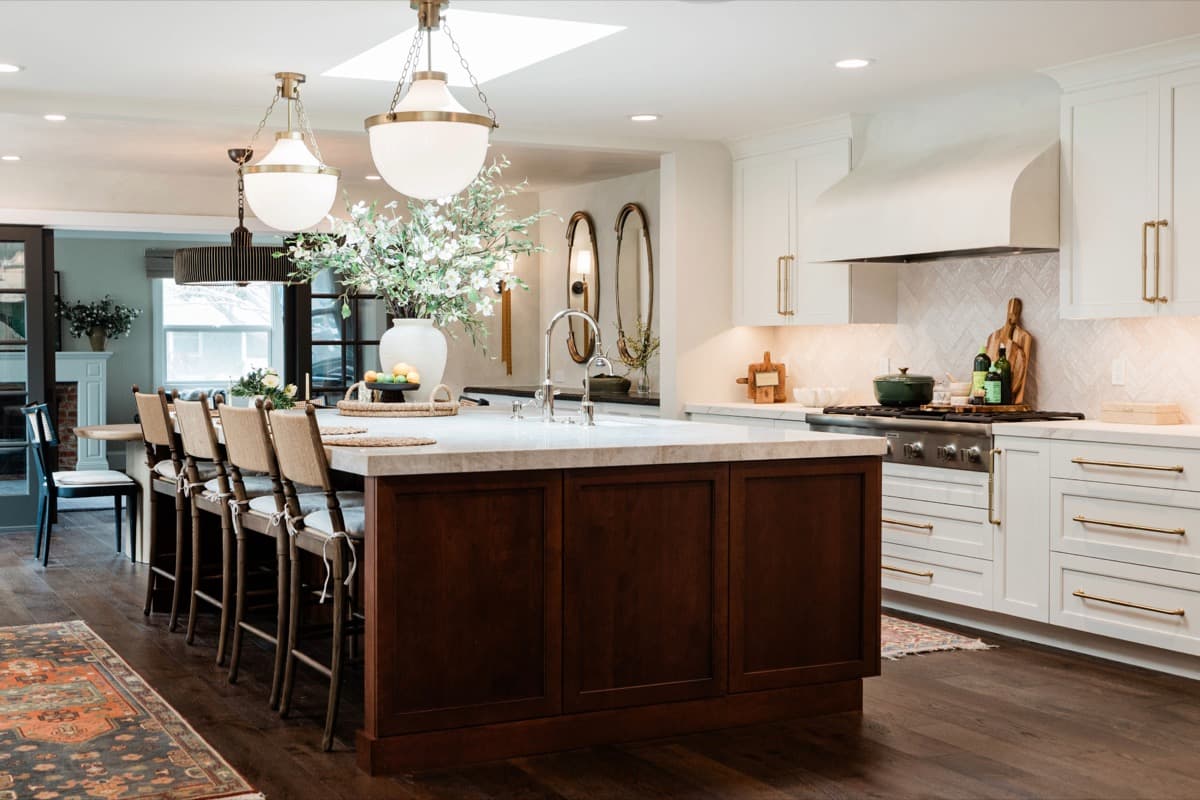
Phase two — In the shop (6 to 10 weeks)
Weeks 1 to 2: Material and shop drawings
The build phase opens with procurement and detailed shop drawings — the working drawings the shop builds from, more precise than the design drawings you approved. We order lumber, sheet goods, hinges, slides, and hardware. Solid hardwood is selected board by board for grain and color, and on a walnut or white oak kitchen this selection is part of the craft, not a formality. Specialty hardware can carry its own lead time, which is one reason it is ordered first.
Weeks 2 to 6: Milling and cabinet construction
Now the cabinets are built. Lumber is milled flat and square, sheet goods are cut, boxes are joined with glued dado construction, face frames are assembled, and doors and drawer fronts are made — including the dovetailed solid-wood drawer boxes. This is the longest single stretch of the project, and it cannot be meaningfully rushed. Glue needs time to cure; joinery cut in haste is joinery that fails. The weeks here are the weeks that buy you decades.
Weeks 6 to 9: Finishing
Finishing is its own discipline and its own stretch of time. Every surface is sanded through progressive grits, then sprayed in a controlled finishing room — stain and topcoat for wood, primer and catalyzed lacquer or conversion varnish for paint — with proper cure time between every coat. A painted kitchen takes longer than a stained one because paint demands more preparation and more coats. Finishing cannot be hurried; a finish that is rushed is a finish that fails early, and the homeowner discovers it long after the shop has gone.
Phase three — Installation (1 to 2 weeks)
Week 1: Setting the cabinetry
Installation is where the careful drawing pays off. The cabinets are delivered and set in place, leveled, secured, and — crucially — scribed to your walls and floors so that every irregularity in the room is absorbed into a clean, level installation. In an older San Jose or Los Gatos home, where nothing is truly square, this scribing is slow, deliberate work, and it is exactly what separates custom cabinetry from cabinetry that was merely installed.
Week 2: Countertop coordination and finishing touches
Here the schedule depends on more than the cabinets. Stone countertops are templated only after the cabinets are set and level, and fabrication then takes its own one to three weeks — which is why countertop lead time often determines a kitchen's true completion date. Once the stone is in, we return for the final pass: doors and drawers adjusted to even reveals, hardware set, panels and trim completed, and a full walkthrough together.
What can move the timeline
- Project size and complexity — a single-wall kitchen moves quickly; a large kitchen with a butler's pantry, a wet bar, and integrated panels takes longer at every stage.
- Design decisions — every change made after approval resets part of the schedule, which is why time spent in design is time well spent.
- Material lead times — specialty hardware, a particular stone slab, or an unusual wood species can each add weeks of waiting.
- Other trades — if cabinetry is part of a larger remodel, electrical, plumbing, drywall, and flooring all have to land in the right order.
- Shop schedule — a custom shop builds one project at a time with care, so your start date depends on the queue ahead of you.
The honest bottom line
Plan on three to five months from your first call to a finished kitchen — a few weeks of design, six to ten weeks in the shop, a week or two of installation, plus countertop fabrication folded in near the end. A complex project, or one tangled into a larger remodel, can run longer.
We know that asks for patience, and we say so plainly. But a custom kitchen is not a thing you order — it is a thing that is made, by hand, for your house and no other. The timeline is not delay; it is the design refined until it is right, the joinery given time to cure, the finish allowed to harden, and the cabinetry fitted to your walls rather than forced against them. Spread across the decades you will use the kitchen, a few months is a remarkably short time to wait. And it is the reason the result lasts.
Written by
Kyle Dickson
Kyle Dickson leads Dickson Cabinet Co., the custom cabinet division of D One Builders, building heirloom cabinetry by hand from the shop in Gilroy, California.